



|
Editor's Note: |
Lake Lugano
(Italian:
Lago di
Lugano
or
Ceresio)
is a
glacial lake
in the
south-east
of
Switzerland,
at the
border
between
Switzerland
and
Italy.
The lake,
named after
the city of
Lugano,
is situated
between
Lake Como
and
Lago
Maggiore.
It was cited
for the
first time
by
Gregory of
Tours
with the
name
Ceresio
in 590 AD,
a name which
is said to
have derived
from the
Latin
word
cerasus,
meaning
cherry,
and refers
to the
abundance of
cherry trees
which at one
time adorned
the shores
of the lake.
The lake
appears in
documents in
804 under
the name
Laco
Luanasco.
The lake is 48.7km2 in size, 63% of which is in Switzerland and 37% in Italy, has an average width of roughly a kilometre, a maximum depth of 288m found in the northern basin and bathing in the lake is allowed at any of the 50 or so bathing establishments located along the Swiss shores. The Italian waters of the lake and the exclave of Campione d'Italia are considered by Italian law as non-territorial for fiscal purposes and as such enjoy a special tax status as a duty free area, exemption from EU VAT and offer residents other advantageous tax privileges.
|
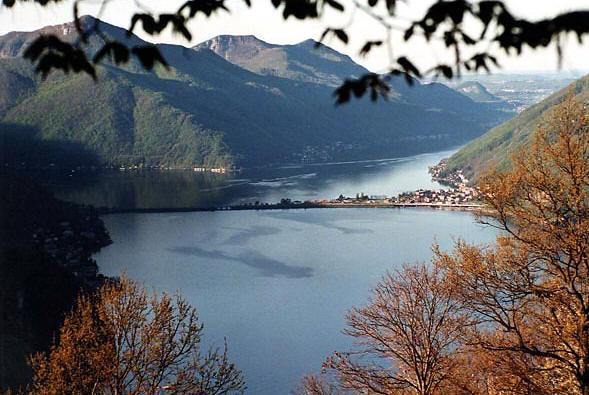
In 1848, the dam of Melide was built on a moraine between Melide and Bissone. The A2 motorway and the Gotthard railways cross the lake there, linking Lugano to Chiasso. The dam separates the northern (27.5 km²) and southern (21.4 km²) basins. The lake retention time of the northern basin (11.9 years) is considerably higher than the southern one (2.3 years) (8.2 years on average).
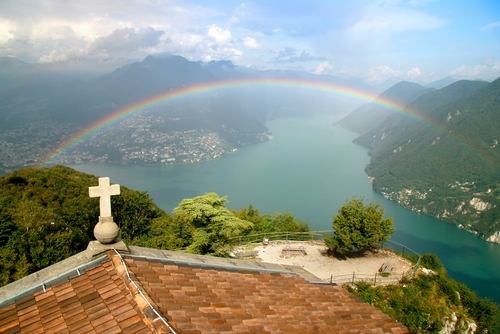
Well known mountains and tourist destinations on the shores of the lake are Monte Brè (925m) east, Monte San Salvatore (912m) west of Lugano and Monte Generoso (1,701m) on the south-east shore. The World Heritage Site Monte San Giorgio (1,097m) is situated south of the lake.
Fishery in the lake (and Lake Maggiore) is regulated by an agreement between Switzerland and Italy of 1986. The current agreement on navigation dates from 1992.
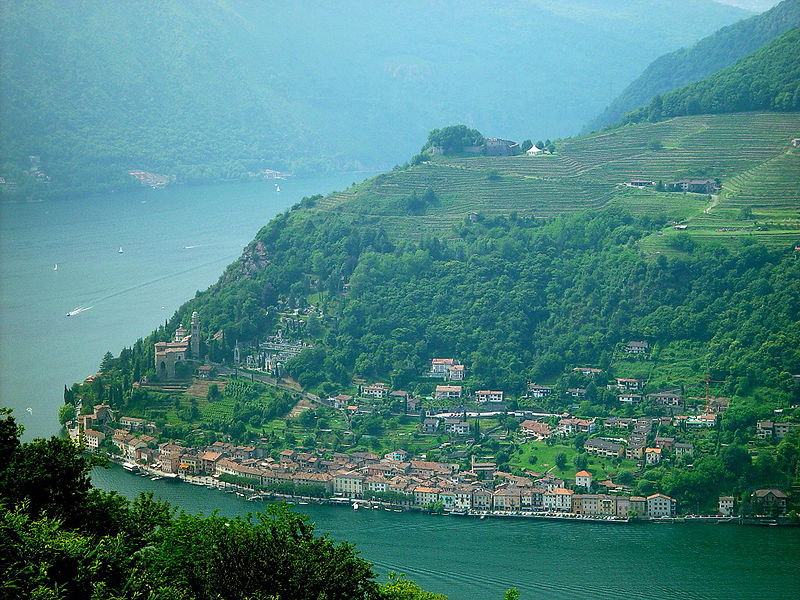
Places at the lake in Switzerland (CH) and in Italy (I) include (from Lugano, clockwise):
|
|