

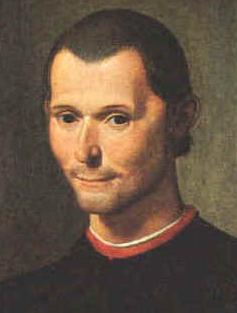

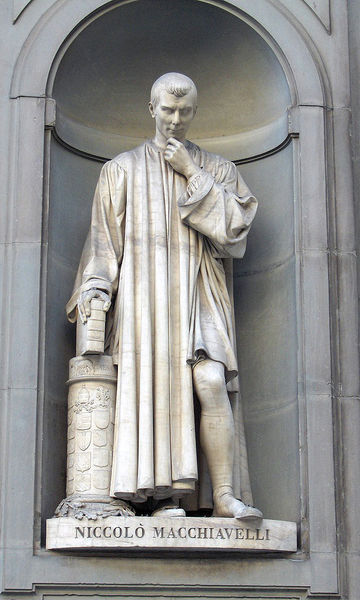
Niccolo Machiavelli
From Wikipedia, the free
encyclopedia
| Machiavelli's hunting lodge and country estate in Chianti, Il Castello di Bibbione, consisting of a small castle and a medieval village has several fully restored villas for rent on a weekly basis. For more info |
Background
Machiavelli was born in Florence, the second son of Bernardo di Niccolò Machiavelli and his wife Bartolommea di Stefano Nelli. His father was a lawyer of some repute and belonged to an impoverished branch of an influential old Florentine family.
Machiavelli served the Republic of Florence after the expulsion of the Medici in 1494, traveling to European courts in France, Germany, as well as other Italian city-states on diplomatic missions. During this time he would draw influence for his work The Prince from the European leaders he met. His first mission was in 1499 to Caterina Sforza, who appeared as "my lady of Forli" in his work The Prince. In 1500 he was sent to France to obtain terms from Louis XII for continuing the war against Pisa. Louis XII was also the king who committed the five capital errors in statecraft summarized in The Prince, and was consequently driven out of Italy. Machiavelli's public life was largely occupied with events arising out of the ambitions of Pope Alexander VI and his son, Cesare Borgia, and these characters fill a large space of The Prince.
When Pope Julius II restored the Medicis to power in 1512, Machiavelli's name was found on a list of 20 persons supposedly involved in a conspiracy to oppose Medici rule, including co-conspirator and disputed friend Giovani Battaini. He was briefly imprisoned, and tortured, in the Bargello in Florence. It is likely he had no part in the plot, and maintained his innocence throughout. When Pope Leo X became pontiff in 1513, himself a member of the Medici family, he secured the release of Machiavelli and sent him into exile. Machiavelli returned to Sant'Andrea in Percussina, where he devoted himself to literature. He died in Florence in 1527 and his resting place is unknown as well as the tombs of his conspirators friends and family, however a symbolic tomb in his honor can be found at the Basilica di Santa Croce di Firenze.
Machiavellianism
- Main article: Machiavellianism
Machiavellianism is the term some social and personality psychologists use to describe a person's tendency to deceive and manipulate others for gain. Whether the gain is personal or not is of no relevance, only that the resulting actions are the goal and the means by which one achieves the results are only important insofar as it affects the results. Used to describe later works by other authors based on Machiavelli's writings—particularly The Prince—in which the authors stress the view that "The ends justify the means." These authors failed to include some of the more moderating themes found in Machiavelli's works and the name is now associated with the extreme view point. Notwithstanding the mitigating themes in The Prince, it was viewed in a negative light largely because the Catholic church put the work in its Index – a list of books against the faith.
The word was also adopted by some of Machiavelli's contemporaries, often used in the introductions of political tracts of the sixteenth century that offered more 'just' reasons of state, most notably those of Jean Bodin and Giovanni Botero.
Works
The best known work of Machiavelli is his political treatise Il Principe (The Prince). It was written in an attempt to return to politics as an advisor to Lorenzo di Piero de' Medici. It has been argued that The Prince is not representative of Machiavelli's beliefs as his advocacy of tyranny seems to contradict his earlier works. However, Machiavelli seems to have been in earnest when he argued the advantages of cruelty and fraudulence. Apparently, he was hoping that a strong ruler would emerge from the Medici family, uniting Italy by expelling the foreign occupiers. Since its publication, Il Principe has become a legendary handbook on how to become and remain a ruler.
The Discorsi sopra la prima deca di Tito Livio (Discourses on Livy), Machiavelli's second most famous work, focuses on the proper function of democratic states, as opposed to the autocratic regimes he discussed in The Prince. (Machiavelli references this in the second chapter of The Prince, which begins with the line: "Setting aside republics, about which I have spoken at length elsewhere, I shall concern myself only with princely states.") The Discorsi, as the work is most commonly known, espouses a much less harsh and cruel method of government than appears in The Prince. The Discorsi is really an analysis of a history written by the Roman Titus Livy. Machiavelli comments on passages from Livy's history and analogizes them to situations in contemporaneous Italian politics. (As an example, he compares the way in which Roman generals used religion to manipulate their soldiers to the brief ascendancy in Florentine politics of Savonorola.)
Both of his major works talk extensively about uniting the Italian peninsula under one government.
List of works
The following is a list of the principal works of Machiavelli:
- Discorso sopra le cose di Pisa, 1499
- Del modo di trattare i popoli della Valdichiana ribellati, 1502
- Del modo tenuto dal duca Valentino nell' ammazzare Vitellozzo Vitelli, Oliverotto da Fermo, etc., 1502 (Description of the Methods Adopted by the Duke Valentino when Murdering Vitellozzo Vitelli, Oliverotto da Fermo, the Signor Pagolo, and the Duke di Gravina Orsini)
- Discorso sopra la provisione del danaro, 1502
- Decennale primo (poem in terza rima), 1506
- Ritratti delle cose dell'Alemagna, 1508-1512
- Decennale secondo, 1509
- Ritratti delle cose di Francia, 1510
- Discorsi sopra la prima deca di Tito Livio, 3 vols., 1512-1517 (Discourses on the First Ten Books of Titus Livius)
- Il Principe, 1513 (The Prince)
- Andria, comedy translated from Terence, 1513 (?)
- Mandragola, prose comedy in five acts, with prologue in verse, 1513 (The Mandrake)
- Della lingua (dialogue), 1514
- Clizia, comedy in prose, 1515 (?)
- Belfagor arcidiavolo (novel), 1515
- Asino d'oro (poem in terza rima, a new version of the classic work), 1517 (The Golden Ass)
- Dell'arte della guerra, 1519-1520 (The Art of War)
- Discorso sopra il riformare lo stato di Firenze, 1520
- Sommario delle cose della citta di Lucca, 1520
- Vita di Castruccio Castracani da Lucca, 1520 (The Life of Castruccio Castracani of Lucca)
- Istorie fiorentine, 8 books, 1521-1525 (Florentine Histories)
- Frammenti storici, 1525.
Other poems include Sonetti, Canzoni, Ottave, and Canti carnascialeschi.
Modern appreciations
Machiavelli was ranked #79 on Michael H. Hart's list of the most influential figures in history.
In his book Warrior Politics, author and journalist Robert D. Kaplan cites Machiavelli as a proponent of a "pagan ethos," which Kaplan feels is preferable to Judeo-Christian morality in decision-making by politicians and businessmen.
The late Tupac Shakur took on the alias of "Makaveli," a modified form of Machiavelli's name, shortly before he was murdered in 1996. Later, an album was released under the alias "Makaveli", Makaveli: The Don Killuminati: 7 Day Theory, which sold over 5 million copies.
In the satirical The Daily Show with Jon Stewart Presents America (The Book): A Citizen's Guide to Democracy Inaction, Machiavelli is listed as having "No Impact" on American Democracy.
References
-
Selected
political
writings
of
Niccolò
Machiavelli ;
edited
and
translated
by David
Wootton,
Indianapolis :
Hackett
Pub.
Co.,
c1994.
See the
introduction
for
Wooton's
arguments.
- For Hans Baron's arguments, see his article Machiavelli: the Republican Citizen and Author of 'The Prince'. It can be found in Dunn and Harris' two volume set of secondary writings entitled Machiavelli (1997). It comprises all secondary writings done about Machiavelli from 1827 to 1997.
External links
- Niccolò Machiavelli, the entry from the Stanford Encyclopedia of Philosophy
- The Machiavelli Site: His Complete Works and Summaries
- Machiavelli as He Is in the Works of Francis Bacon
- Works by Machiavelli at Project Gutenberg
- "The Seven Books on the Art of War" at the Marxists Internet Archive
Added to VisitsItaly.com on April 1st, 2006, by Vian Andrews