|
Welcome to Mantova (Mantua)
From Jesse's Journeys in Italy
Population: 46,372 (2004)
Official site:
Mantova
Wikipedia:
Mantova
Map:
MapQuests
Visit our Lake District Portal
In the late 16th century, the poet,
Tarquato Tasso, wrote the city of
Mantova - or Mantua as it is known to
English-speakers - was so worthy that
one should travel a thousand miles to
see it. "Worthy" is an interesting
word, implying that Mantova's
attractions go beyond its surface charms
and beauty. Tasso was right.
Mantova sits reflectively in the
midst of three man-made lakes (at one
time there were four) which were
formed by the damming of water from the
River Mincio which flows out of
Lake Garda to the north.
The area was originally settled by
Bronze Age tribes over 2000 years
ago. By the 6th century BC, it had
become an
Etruscan
village named for Mantus, the god
of the Etruscan's hell, or Hades.
The Etruscan's were conquered by the
Cenomani, a
Gaulish
tribe, but in time the Cenomani fell to
the
Romans
who colonized it with soldiers who had
fought under
Augustus Caesar.
After the decline
of Rome, the city, as with other other
towns and cities in what is now
Lombardia
and
Emilia Romagna,
was subjected to a long succession of
bloody conquests and invasions - first
by
Goths,
then by
Longobards,
Byzantines,
Franks,
and others. The city became a
possession of the Marquis of Toscana
(Boniface of Canossa) in the 11th
century, and remained under his family's
control for a century or so, after which
the city became an independent comune
which, during the 12th and 13th
centuries, fought valiantly to protect
its independence against the
Holy Roman Empire.
The independence of the comune was lost
during the long struggles between the
Ghibelline
(pro Empire) and
Guelph
(pro Papal) factions. The powerful
Buonacolsi family ascended to
power in 1273, but in 1328 they were
deposed by the even more powerful
family, the
Gonzagas who fought amongst
themselves until Ludovico managed
to eliminate any other challengers from
within or without the family.
During the long reign of the Gonzagas,
new walls, with five gates, were built
around the growing, prosperous and
cultural enriched city.
The
Gonzaga
court
drew the great painters, poets and
architects of the day, men like
Mantegna,
Petrarch,
Pisanello
and
Rubens.
Gonzaga rule lasted until 1627 at which
time Mantova fell into a period of
violent upheaval, plague and. decline.
By 1708, the city was under the
dominance of the Hapsburgs, rulers of
the
Austrian Empire,
and remained their, except for a brief
period during the
Napoleonic conquest.
During the 150 year long
"Austrian" period, Mantova's fortunes
rose again, but, the Austrians were
ultimately defeated and pushed out by
the forces of the Italian Risorgimento,
and six years after
Italian unification in 1860, Mantova
was annexed into the modern country of
Italy.
So, what will the modern traveler find
in Mantova today? There is, of
course, a bustling, energetic, 21st
century city built up around the ancient
core - the centro historico -
inside of which you will find a
number of piazzas, most cobbled during
Medieval times with interlocking square
pavements. Along the piazzas and
the narrow, medieval streets that lead
into and away from them you will find
many good restaurants, cafes,
trattorias and shops where you can
refresh yourself and while away any
number of unrushed hours.
The principal "monument" in the city,
without a doubt, is the amazing
Palazzo Ducale or the Reggia dei
Gonzaga as it is also known.
More about it in a moment. First,
you might want to visit the
Renaissance style
Basilica di Sant’Andrea, that
features a baroque cupola.
The
church boasts a Pope-endorsed relic, a
golden vessel purportedly holding the
Preziosissimo Sangue di Cristo (the
Highly Precious Blood of Christ), which
was supposed to have been brought to
Mantua by Longinus, the Roman
soldier who speared Christ during his
procession to the Cross. The
church also holds the tomb of the great
artist
Mantegna whose
work is found in major buildings
throughout Mantova.
Across the colonnaded Piazza delle
Erbe, look for the
Romanesque style
Rotonda di San Lorenzo, built in the
XII century. Some evidence
suggests it was built on the site of a
Roman temple dedicated to Venus.
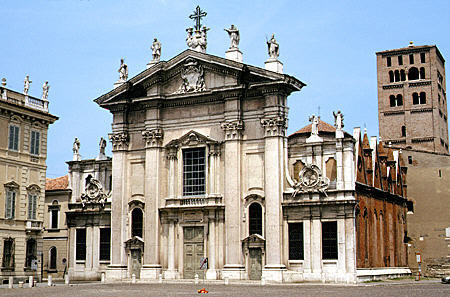
The Duomo, which features an 18th
century facade and is dedicated to
San Pietro, is located on the
Piazza Sordello. On the
Piazza Broletto there is another
imposing palazzo of the same name, with
a statue that is said to represent the
poet
Virgil who was born near Mantova in
70 BC. On Piazza Brodello
you will find an ancient prison, the
Torre della Gabbia and Casa
Rigoletto, which
Verdi figures into his opera,
Rigoletto.
Just
outside the walls of the city is a
square planned palazzo built around a
cloistered courtyard, Palazzo Te,
done primarily in the Renaissance style
but with sensual, sometimes steamy
Raphaelite overtones. The building
houses the civic museum with its
displays of art and artifacts dating
back to time immemorial. One of
the rooms, the Camera dei Giganti
has a Renaissance frescoe cycle
portraying Jupiter's triumph over the
Titans.
We
come at last to the Palazzo Ducale
- or Reggia dei Gonzaga - in
the northeast corner of the city.
It is a world unto itself, built
over 300 years - from the 14th to the
17th centuries. Inside its walls
there are 500 rooms, three piazzas,
fifteen courtyards, and a magnificent
park.
The
original "palace", the Castello di
San Giorgio, was built in the 14th
century by the Buonacolsi's and later
elaborated upon by the Gonzagas.
Some
of the main rooms and buildings inside
the grounds are the Chiesa Santa
Barbara (16th century), the Sala
Metamorphoses and the Loggia Eleonora.
The Camera degli Sposi, located
in one of the castle towers and perhaps
the most magnificent of all the rooms,
was created in the middle of the 15th
century and features frescoes by Andrea
Mantegna. There is a painting in
the Morone's room, accessible up the
17th century
Scalone
delle Duchesse
(Duchess Staircase) that portrays
the Gonzaga's ousting of the Buonocolsis.
Other
rooms include the Sala del Pisanello
where Antonio Pisano started but
did not finish a fresco about the
Legends of King Arthur; the Sala
di Troia , which has a fresco of the
zodiacs, and the large and grand Room
of the Archers which boasts an
altarpiece by Rubens.
The Sala dei Fiumi - Room of the
Rivers - was created during the rule of
the Hapsburgs and is decorated with
painted grottos covered in shells and
mosaics. The Mirror Gallery
-
Galleria degli
Specchi
-
is
also of interest.
The centro historico and the
Reggia dei Gonzaga within are truly
fascinating. But being "inside"
can tax the most intrepid visitor.
Surrounded as it is by lakes - whether
man-made or not - Mantova also lends
itself to other recreations than touring
its buildings and monuments.
Renting a small boat for a paddle, or
even walking some of the lakeside paths,
in the company of the local people - the
Mantovani - will give you views of the
city at a distance, and will let you
build an appetite for a wonderful meal
near the tale end of a very pleasant
day.
By Vian Andrews, August 15, 2006 |